Hopes of a Peace Agreement Rise
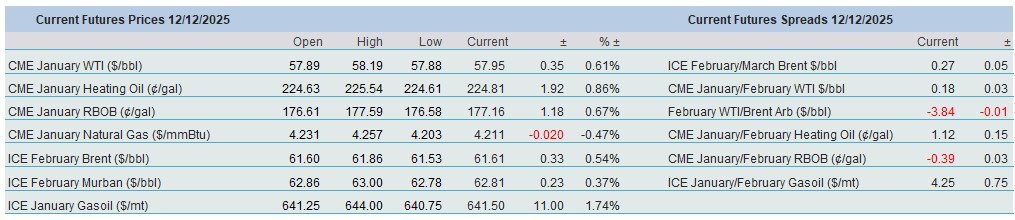
The oil market finds it increasingly challenging to rally sustainably, at least this is what yesterday’s and, in general, this week’s performances imply. There is now a growing belief that more supply will be available soon. Since Heating Oil and Gasoil are driving the current move lower, it is a safe bet to deduce that this potential extra volume of oil will come from Russia. The two crude oil futures contracts fell around 90 cents/bbl yesterday, but the retreat was twice as steep in Heating Oil.
Diplomatic efforts are clearly intensifying between Russia and the US, and the invader made it clear that it would welcome foreign investment once sanctions are lifted, a potentially irresistible carrot for a transactional USA administration. The sad irony of the ongoing talks, which would clearly favour Russia and would most plausibly force Ukraine to give up part of its territories that are currently under its own control, is that whatever sanctions are in place, they are effective, Russia is actually suffering from low oil prices and without the staunch and unwavering US support, the prospects of a peace or truce would look very different. Just think of falling Russian export revenues, which plunged to their lowest since the break-out of the war, the IEA estimates or Urals in NWE, which is worth less than $40/bbl. Yet, conviction of a Russian-friendly agreement is growing and not even the US unilateral seizure of a few million barrels of Venezuelan oil or a Ukrainian strike on a Russian oil rig in the Caspian Sea could reverse the sentiment, although the Trump threat to intercept more ships carrying Venezuelan oil provides temporary relief this morning.
Bleaker 2026
None of the three major forecasters, the EIA, the IEA and OPEC, felt the need to make substantial changes to their supply and demand predictions, which also means that the gaps between their views remain significant. There is, nonetheless, a consensus that next year, as the latest snapshot suggests, will be looser than both 2025 and 2024.
We touched upon the EIA’s findings in Wednesday’s report and concluded that there will be no impending oil shortage; quite the opposite. After registering a global oil surplus of 370,000 bpd in 2024 and 2.24 mbpd in 2025, global oil supply will exceed consumption by 2.26 mbpd next year, resulting in OECD oil inventories topping 3 billion bbls. This predicted swelling of inventories justifies the associated price forecast. The EIA projects Brent to average $55/bbl (the current curve is just over $61/bbl). It is not expected to deviate significantly from this level over the next year, as the OPEC+ production policy and ongoing Chinese SPR purchases will prevent the price from falling sharply.
Before turning to the IEA and OPEC supply and demand figures, it is worth stressing that, in addition to absolute demand levels, there is disagreement over which will grow faster in 2026. Both the EIA and OPEC believe that demand growth will outpace the rise in non-DoC supply; therefore, the call on non-DoC oil will also climb, by 530,000 bpd in the EIA’s view and by 630,000 bpd in OPEC’s estimation. Conversely, the IEA sees demand rising by 900,000 bpd next year versus an increase of 1.18 mbpd in non-DoC supply and 250,000 bpd in DoC other liquids, leading to a 520,000 bpd contraction in the DoC call.
The diverging views between the IEA and OPEC have frequently been highlighted in this report. Of late, it appears that it is the OECD’s energy watchdog that is attempting to make amends, rather than the other way around. In its updated monthly report, the IEA increased its 2026 demand growth estimate by 100,000 bpd to 900,000 bpd. The supply surplus, therefore, has been revised lower. But before those with bullish inclinations start irrepressibly pressing the buy button, the extent of the anticipated stock builds needs to be examined. Assigning an average 2026 production level of 43.95 mbpd to the extended producer alliance, one finds that global oil inventories will swell at a rate of 3.8 mbpd throughout next year, pushing OECD industrial stocks up to 3.527 billion!! bbls by year-end.
OPEC was satisfied with its November findings and left both its supply and demand estimates for 2026 broadly unchanged. Absolute demand at 106.55 mbpd is 1.75 mbpd higher than the equivalent IEA estimate and 1.4 mbpd higher than in 2025. On the supply side of the oil balance coin, non-DoC liquids increase by just 600,000 bpd. The call on DoC oil remains unchanged at 42.98 mbpd, which is 2.83 mbpd above the IEA figure. Using the same DoC supply assumptions, OPEC believes global stocks will build by 980,000 bpd, with OECD inventories ending 2026 at 2.91 billion bbls, some 576 million bbls below the IEA estimate.
The gulf is unprecedented, making any price forecast based on stock levels a cumbersome exercise. Fortunately, help is at hand. The logic is as follows: we know this year’s quarterly average prices, along with OECD stock levels. We are therefore not concerned with absolute stock estimates, only with quarterly stock growth projections, because these hold the key to calculating quarterly price changes. All three forecasters expect inventory builds in every quarter of next year. Thus, based on the inverse relationship between OECD stocks and Brent, it is reasonable to conclude that 2026 quarterly prices will be lower than in the corresponding periods of 2025. How much lower? Using OPEC’s numbers, the most conservative estimates, the quarterly price declines will average out around $13/bbl, with 2Q registering the sharpest price drop. This implies an average Brent price of $55.26/bbl for 2026 as a whole, since the 2025 Brent mean will be around $68/bbl. Based on OPEC’s forecasts, our formula produces the same result as the EIA’s.
Overnight Pricing
12 Dec 2025
