Japanese Dodgeball
The hand wringing seen by the Bank of Japan has led to the bank’s favourite exercise in deploying deferment. Governor Kazuo Ueda will have to step rather gently when addressing the future because of the recent selloffs in domestic bonds and the Yen. Keeping rates unchanged today might buy time while Prime Minister Sanae Takaichi goes about her snap election to confirm the appetite for plans to increase stimulus, but it will not alleviate a market-wide concern that troubles are being bottled up for the future. Indeed, speculation will continue to run rife on how and when the BoJ must step in to protect its ailing currency which is almost stimulus by another name and probably just as expensive. Still, the rest of global bourses breathe a sigh of relief because the last thing investors need at this sensitive time is having to build in slippage from a possible change in exposure to any Yen ‘carry trade’ if rates had been hiked. There is audible exhalation at the end of a tempestuous week and while markets have once again been proved right in not believing anything the so-called leader of the free world says, Donald Trump’s petulant ramblings will not be his last, therefore, all places of investment are right to stand in a state of unease. If, in fact, the Donald wishes to claim any sort of victory that stands up to scrutiny, then it is how he has single-handedly rallied the price of Gold by $2000/ounce in one year.
Season's Greetings
There is a bout of bullishness swinging through the energy complex inspired by extreme seasonality. It does make a change from having to justify or pick apart nonsensical foreign policies of flighty politicians and the power words wield over the progress of oil and energy prices. As much as bears fire bullets of oversupply at vulnerable rallies, the winter of 2026 has not fully had its say in proceedings and if one believes some of the forecasts, then the freezing conditions set to turn collars higher in protection from the cold, rather than being a shield from the madness of contemporary geopolitics, then good old-fashioned demand from higher heating use and how long it lasts is a welcome fundamental breather from our new favourite FT-named ‘ego-politics’.
In the United States, the Weather Prediction Centre (WPC) of the National Weather Service continues to warn on disruptive systems spreading down from Canada which will initially hit the Northeast part of the US today creating snow squalls and driving, freezing winds. This in turn will drive dangerously cold and very dry Arctic air stretching down to the Southern Plains, Mississippi Valley and Midwest with the coldest wind chills hitting -50 degrees Fahrenheit (-45 Celsius). Some 30 States will feel the effect from New Mexico to New York and the hyperbole in US media would have one believe that this is a ‘generational storm’, ‘potentially catastrophic’, one that ‘defines the entire winter’ and has indeed been named by the Weather Channel as ‘Winter Storm Fern’ potentially bringing chaos to 180 million Americans, half of Uncle Sam’s population. At present, the weather data sets are pointing to Dallas as being in the line of freeze in Texas, but the more sensitive oil areas further south around Houston and those of Louisiana look set to be spared. Still, Natural Gas prices are soaring, on Wednesday alone M1 Henry Hub futures rose 20% and at 5.50 MMBtu has outstripped the highs of 2025 posted last month and are now at levels not seen since December 2022. The activity and scramble for a defensive posture in positioning are noted by the CME. It announced that its natural gas complex reached a new single-day record of 2,576,346 contracts traded on January 20, up 15 percent from the previous daily record of 2,239,081 contracts traded on November 14, 2018.
In Europe because of anomalies associated with the Polar Vortex, icy Siberian weather is being encouraged to sweep westward as prevailing winds flip. While much of the reduced temperatures will invade the Nordics, Baltics and Eastern reaches of Poland and Hungary, the West will be insulated by warmer winds coming off the Atlantic. However, because of the inconsistency of the disruption in the Polar Vortex, predictive computer patterns are not blessed with high confidence. If a cold spread wanders across the likes of the Netherlands, Germany and France, the ability to cope with an increase in heating demand is jeopardized on how, and according to Trading Economics, Gas storage is now about 49.9 percent full, well below that of 61 percent seen at the same time last year and almost 14 billion cubic metres under the five-year average. Dutch TTF M1 futures have rallied €10 Mw/H to nearly €40 in just over a week.
Looking further East, China, Korea and Japan are seeing temperatures plummet with the very same Arctic Polar Vortex sending frigid air as far south as Afghanistan and India. The Straits Times quotes meteorologists pointing out how the cold wave “stands out for both the intensity of the cold air and its spatial extent”, and that January could be the coldest across East Asia since 2021. HDD (Heating Degree Days), the measure in which energy demand is calculated by taking how many degrees the temperature is under the base18 Celsius and multiplying them by the number of days below, have increased by 25 percent over the 10-year average. LNG Japan/Korea Marker (JKM) M1 future has rallied by over 10 percent this week to $11.50 MMBtu which when combined with the perceived demand that the uniform cold weather being experienced as outlined above, competition for the liquified form of energy has suddenly increased.
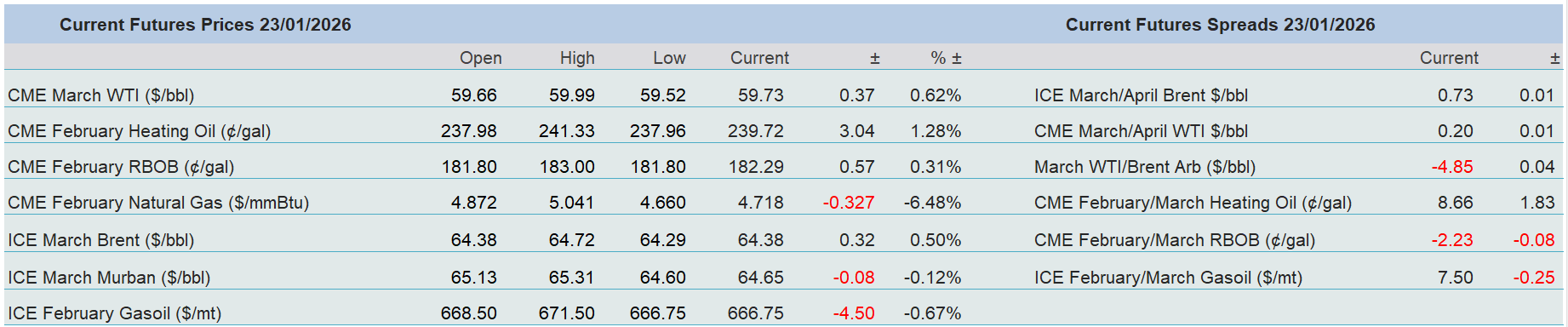
Not only is Heating Oil driven by its own seasonal demand, the sudden spate of buying in all forms of Gas is adding another reason to take a kind eye toward oil distillates. CME M1 Heat futures price has increased by 28c/gallon or 13 percent so far month-to-date. Similarly ICE M1 Gasoil futures has pushed on by over $45/tonne or 7.5 percent MTD. While not exactly precarious, the state of global distillate stocks is low and must be of concern which is why there is anticipatory length being built. According to the EIA, US distillates are 3.348mb or 2.8 percent higher than last year. Whereas PJK International points to ARA inventories being -394k tonnes or -16 percent, with Enterprise Singapore seeing the Asian hub -444k litres or -5 percent compared from a year earlier.
With the idea of ‘fuel switching’ where oil might just be burned in place of Gas forms, or if in fact the freezing fingers of Winter Storm Fern take an icy grasp upon the refineries of the lower United States, the current rally will accelerate and will have a profound impact on the oil complex as a whole. Whatever happens, a good freeze and blanket of snow might just cover the political detritus we need step through most days. Well, at least for a welcome while.
Overnight Pricing
23 Jan 2026
