No Time for Winter Blues Thank You, We're Just Too Busy
Unsurprisingly, the US Federal Reserve held interest rates, and according to Jerome Powell was done so with broad support within the Federal Open Market Committee. With his eyes on Iran at present, as discussed below, there has been little reaction from the US President who is unlikely to shy away from further criticism of the Fed Chair and the conservatism by the FOMC in monetary policy. Dissension was left to Trump’s leading ally Stephen Miran and Christopher Waller, one of the few candidates left in the reckoning to replace Powell at the end of his tenure, who both backed a 25-basis point cut. In his press conference, Powell spoke on strength in the economy, and slightly reduced risks to inflation and employment, but still stayed with his stump speech of being driven by data trends and described the Fed as being well positioned when a change was needed.
Despite the lack of an easier monetary decision from the FOMC, stock markets were initially cheered by the post-decision language but the way higher for bourses is a complicated one as investors become inundated with results from the big drivers of technology stocks. Microsoft earnings for the fourth quarter were up 17 percent, but its record amount of spending on A.I. and cloud revenue growth being only just above expectation, shares took a post-close dive of 7 percent. Against that, Meta shares jumped at one point by 9 percent because not only of better-than-expected fourth-quarter sales, but the issuing of a very positive first-quarter guidance. Tesla investors breathed a sigh of relief as results squeaked past expectations and were rewarded with a 2 percent positive nudge. At time of press bourses are tracking back a little, with the picture not fully complete from results and the worsening geopolitical landscape.
Indeed, the world remains a scary place, well at least according to the Doomsday Clock, which is now set at 85 seconds to midnight (catastrophe); the closest it has been in the nearly 80-year history of the clock. The metaphorical measure from ‘The Bulletin of the Atomic Scientists’ noted international cooperation going backwards on nuclear weapons, climate change and biotechnology, while artificial intelligence poses new threats. Something not lost on the financial haven seekers of the world and with the US Dollar unable to shake the attention of its detractors, the world’s money continues to pile into Gold which this morning is just shy of $5,600/ounce.

Iran climbs to the top of the ladder of importance
Accommodating some 3,200 sailors and 2,480 in its air wing, the USS Abraham Lincoln has the population of a small town. However, such a similar size small town is not ordinarily equipped with around 90 of the most advanced aircraft able to project devastating military power across a 1,000-mile radius. The aircraft carrier’s value is purported to be close to $7 billion with its running costs estimated at $2.5 million per day. A staggering expenditure but one that does not include the cost of its accompanying ships. With at least 4 destroyers in its flotilla and probably a shadowing submarine, along with service vessels, the strike group had been operating in the South China Sea but as widely reported has been redirected to US Central Command (CENTCOM) area of responsibility in the Middle East in response to escalating tensions with Iran. According to SpecialEurasia, alongside the carrier, US military assets including F-15E Strike Eagles and tanker aircraft are being deployed or repositioned to reinforce air power in the region. Therefore, taking all the costs and complicated logistics of moving around such mighty pieces of the US military chessboard, it is difficult to not speculate that this is just more than a feint or as described by many as conducting “coercive deterrence.”
Iran may have hydra qualities in the way it spreads war into the world, but its capabilities have been dramatically reduced under the recent attention from the Israel Defence Forces. Therefore, calling this US strategic shift of militaria ‘deterrence’ is a misnomer and ought to be called “coercive projection.” Frankly, Washington owes reparation in action for the Iranian protestors. Two weeks ago, Trump urged anti-government actors to "keep protesting", saying "help is on its way", but when it came to it the US had to walk back such a promise because the swashbuckling Trump was eventually talked down by his military commanders who convinced him on how the US did not have the pieces on the board to conduct any plausible attack that might benefit the civil uprising. It now does. It is also an opportune moment for the US to bring Iran’s failure to comply with it nuclear weapons agreement and of course, Tehran has become more belligerent after the combined US and Israel targeting of atomic capabilities back in June of last year.
Despite the reports of strike aircraft and their tankers being moved to neighbouring military bases, if any operation against Iran is undertaken it will come without the aid of key Gulf allies. Both Saudi Arabia and the UAE have assured Tehran that they will not allow their countries to be used as any sort of platform for an American airstrike. In 2019, during Trump I, Iran proxies attacked Saudi’s oil installations and Riyadh has continually sought to never be in open confrontation with Tehran. However, and according to the WSJ, former high-ranking American military officers said that the Saudi and UAE move would hamper the Trump administration’s planning for military action but would not prevent it if Washington was determined to act. The worry expressed by neighbours not wishing to antagonise a besieged Iran aligns with how oil market participants envisage Iranian reprisals should the US indeed attack. Striking out and damaging the surrounding oil production of its neighbours would be a disaster compared with if the world only lost the 1.5mbpd export flows from Iran due to attack or sanction enforcement.
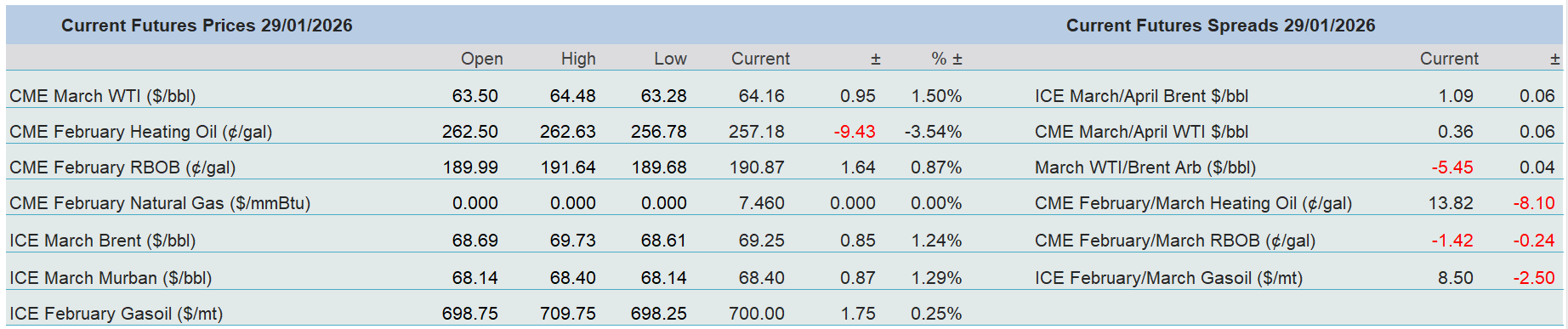
What has made the whole Iranian situation even more intriguing, and as seen on Reuters, is the instruction by PetroChina to its representatives to cease buying Venezuelan crude that is in the control of the US. This would give China even more interest in lifting from other sources including that of Iran and bringing it once again into the crosshairs of US sanctions, and with it increased tension in trade and diplomatic relations. Whatever risk premium is being built into a military strike by America on Iran, it might just have to be skewed a little higher. Direct action or attempts at a regime change have been warned against by Iranian officials and that any attack would mean 'all-out war'. As frightening as what that would look like, the immediate concern for those of with an oily eye is the collateral damage done if Iran takes a swing at its neighbours or possibly even more tellingly, it closes the Strait of Hormuz to the 20mbpd of oil that navigates it.
Overnight Pricing
29 Jan 2026
