Wishful Thinking or More than Rumours?
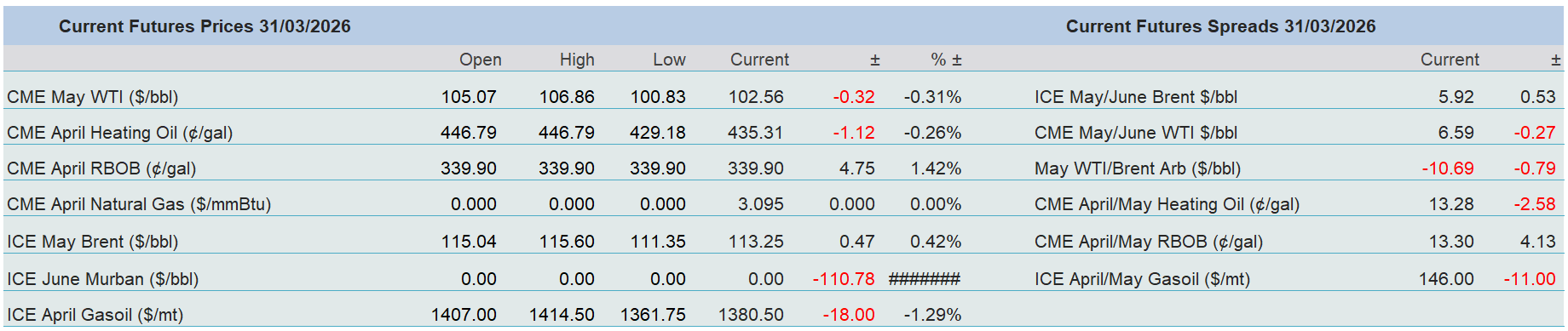
Whether the sharp sell-off in oil prices yesterday and the rally in equities were the result of end-of-month and end-of-quarter positioning or unconfirmed reports of Iran's willingness to end the war is unclear. In the latter case, the reopening of the Strait of Hormuz will be in focus. The possibilities are discussed below. What were, nonetheless, factual developments were the strengthening of the backwardation in both the WTI and Brent structures, notwithstanding the fall in outright prices, renewed overnight attacks on the Gulf states and Iran, and the US warning its citizens in Saudi Arabia to shelter due to alleged threats against US interests in the country.
The situation remains fluid; assumptions, half-truths, and outright misinformation and disinformation are spurring market participants into action. Donald Trump will reportedly address the nation tonight and said that the US could leave Iran regardless of whether there is a deal with Iran. It is, however, worth pointing out that even in the case of a tentative and potentially fragile peace agreement, truce, or US withdrawal, the recovery from the already inflicted damage will be painstakingly slow. The monthly Reuters survey put last month’s OPEC production at 21.57 mbpd, 7.3 mbpd below the February level. Almost all of it came from Persian Gulf nations, and if this figure is even remotely accurate, global oil stock draws for March and beyond are guaranteed.
What does the Future Hold for the Strait of Hormuz?
Beyond the inevitable human tragedy, the most salient and practical question in the perpetual war between the US, Israel, and Iran is when the pivotal chokepoint, the Strait of Hormuz, will reopen. This is what Iranian parents, Persian Gulf energy companies, insurers, shipping firms, airlines, car drivers all over the world, and even those doing their daily grocery shopping want to know. The importance of the Strait has always been obvious; the impact of an eventual closure has not, until now. There is no real alternative to it. Or, to rephrase, while the supply of energy that usually passes through this narrow waterway can be redirected to a certain extent, for example, through the East-West pipeline to the Red Sea, other critical resources, such as fertilisers needed for half of the world’s food production, or helium (a by-product of natural gas production used in the manufacture of semiconductor wafers), are almost impossible to reroute. From the opposite direction, the passageway is responsible for allowing imports into the Middle East, such as food, medicines, and technological supplies.
Iran’s decision to shut down the Strait or, at the very least, to considerably disrupt traffic runs counter to international laws and conventions. There are maritime borders in the Strait of Hormuz between Iran (on the northern side) and Oman (on the southern side). A 1974 agreement between the two countries divides the Strait down the middle and defines territorial waters and seabed rights. Shipping lanes, however, do not follow this border. Ships pass through Omani and Iranian waters interchangeably, as the Strait is governed by the “transit passage” regime under the United Nations Convention on the Law of the Sea. Therefore, Iran’s action of blocking this artery is illegal, to put it mildly. So too, argue legal experts, is the US attack on the Persian Gulf country, as it defies both the US Constitution and the UN Charter’s prohibition on aggression. Iran, therefore, morally and possibly legally, feels entitled to defend itself against the aggressor. Every war, including this one, begins with one side striking back.
To return to the original question, it is anything but clear when the Strait will be fully functional again and shipping normalised. It provides enormous leverage for Iran, and its actions over the past month have shown that it does not shy away from using this leverage to devastating effect. Several scenarios could lead to a reopening; however, each would require an alignment of military, political, and economic conditions.
A ceasefire between Iran and the US/Israel is the most straightforward way to end the nightmare of the past month for all stakeholders in the conflict. At the same time, it is also the least plausible. The US President has floated the idea of militarily securing the waterway, at times demanding and at others denying support from fellow NATO members. Collective mine-clearing and escort operations could be conducted without a ceasefire, though this would be a risky undertaking given the threat to US military personnel and the potential damage Iran could inflict on naval vessels. Iran might also decide to unilaterally reopen the Strait due to domestic economic pressure. Given the resilience and determination of the incumbent regime, such a move does not appear imminent. As reported by The Wall Street Journal, President Trump has also contemplated ending the military campaign against Iran, only to resume it if the Strait remains closed in the foreseeable future. He can, as we learned overnight, also throw in the towel, an embarrassing alternative.
The most intriguing possibility, reportedly being considered and even partially implemented by the Iranian leadership, is the establishment of a “tollbooth,” likely on both sides of the Strait. The idea of charging $2 million per vessel has been entertained. In the case of oil, a VLCC carrying 2 million barrels would incur an additional cost of roughly $1 per barrel under such a scheme. The per-barrel cost would be lower for the rare ULCC voyage and higher for smaller vessels carrying refined products.
Considering that around 3,000 vessels per month, or roughly 100 per day, pass through the Strait, monthly revenue could reach approximately $6 billion ($200 million per day). This could effectively replace 2 million barrels per day of Iranian crude exports at $100 per barrel, providing a critical economic and military lifeline for the regime. Such a plan could go a long way toward helping Iran emerge from the conflict in a stronger position. Whether the US would allow this remains impossible to determine. As noted by the Financial Times, Donald Trump has even mused about “me and the ayatollah” jointly managing the Strait. Would this imply sharing toll revenues? It sounds bizarre (which is normal in the transactional Trumpian universe), yet lest we forget that by recently waiving sanctions on Iran, the US has already provided indirect financial support to the regime. The result is utter chaos and further loss of credibility. Let us see what tonight’s presidential address brings.
Overnight Pricing
01 Apr 2026
